The Data Center Fight Happening in Your Backyard: What Cincinnati & Dayton Buyers Need to KnowData centers have become one of the fastest-moving stories in Ohio real estate. If you're buying,

Dated: September 3 2026
Views: 3
 The Data Center Fight Happening in Your Backyard: What Cincinnati & Dayton Buyers Need to Know
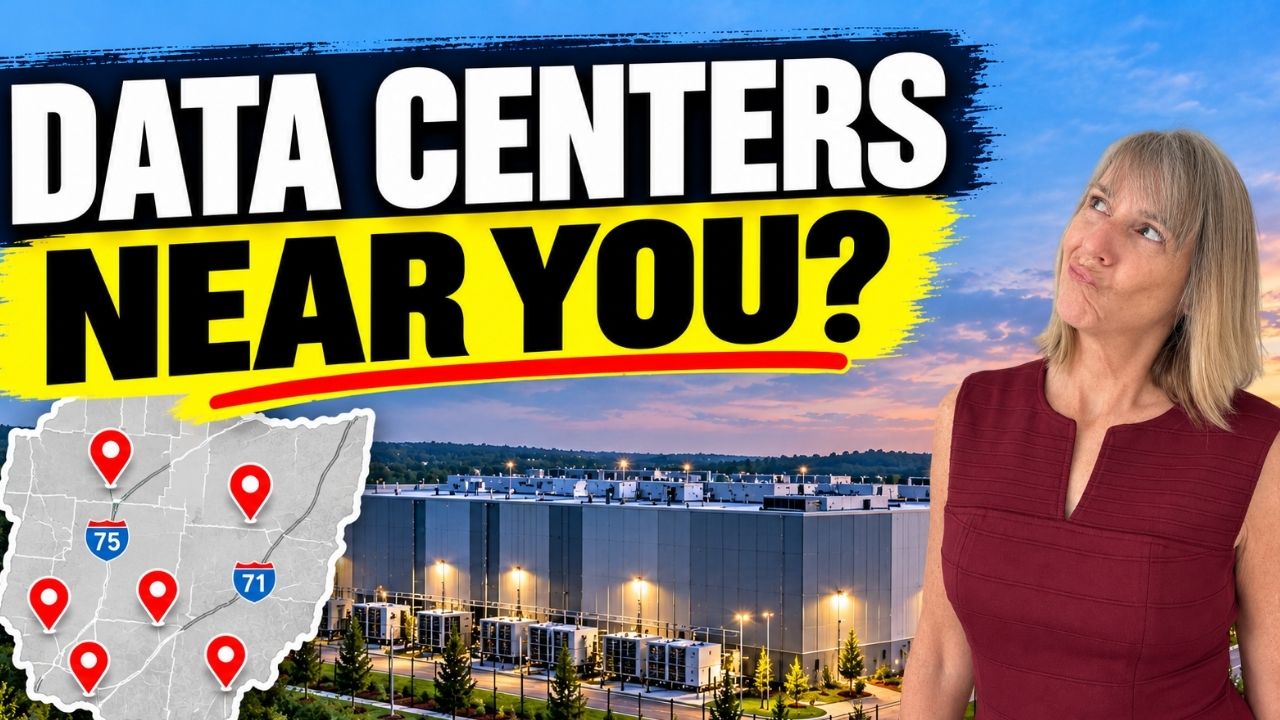
Data centers have become one of the fastest-moving stories in Ohio real estate. If you're buying, selling, or just keeping an eye on your neighborhood, here's what's actually happening — county by county — without picking a side.
Butler County is where things are moving fastest. In Trenton, Prologis received approval for a 250-megawatt data center campus called Project Mila — 141 acres sitting just east of the Molson Coors Trenton Brewery off Woodsdale Road. The planning commission approved it in a 10-minute meeting with no public comment period.
That's not even the biggest story there. Amazon has separately tried to annex roughly 600 more acres from Madison and St. Clair townships for an even larger project, offering both townships $5 million each. Madison Township trustees rejected the annexation unanimously, saying they weren't given enough information soon enough. A resident-led effort to get a local ballot measure in front of Trenton voters was also rejected by city council in a 4-3 vote — that fight has since gone to the Ohio Supreme Court.
In Hamilton, a proposed data center along the Great Miami River — next to Miami University's Hamilton campus and about 50 homes — could require up to 240 megawatts, roughly the electricity use of 24,000 households. That project is currently on pause. West Chester already has one operating.
Cincinnati City Council voted in April to extend rules requiring any new data center to go through a formal planning commission review before approval, weighing neighborhood impact, water and electricity use, and public benefit. Dayton went further: after a 180-day moratorium in April, the city permanently amended its zoning code in June to prohibit large-scale data centers outright.
South along the Ohio River near Manchester and West Union, Amazon Web Services is evaluating more than 1,000 acres on the old J.M. Stuart power plant site. A utility filing shows the project could eventually need 1,300 megawatts — more than 20 times what the entire county currently uses. It's in federal permitting now, with organized resident opposition.
Clearcreek Township passed a one-year moratorium on data center permits — a proactive move, since no project has actually been proposed there yet.
This one has become a statewide cautionary tale. In Mt. Orab, a village of about 4,400 people, the mayor and every village council member signed non-disclosure agreements with a developer called DB Stu LLC before residents knew a 1,000-acre data center mega-site was being negotiated. Council quietly rewrote the zoning code to accommodate it, with no explanation given.
Residents found out weeks later and packed a council meeting. One council member publicly rescinded his own NDA on the spot and proposed a 180-day pause on new permits. This scandal is a major reason state lawmakers introduced legislation to ban these kinds of secrecy agreements between local officials and developers.
About 50 miles northeast of Cincinnati, Wilmington is facing one of the largest proposals in the region. Amazon Web Services wants to build a $4 billion, 471-acre campus off U.S. 68, with a minimum of 100 permanent jobs and an $8 million annual payroll. A second, separate 500-acre rezoning was then approved for another company, Ardent Technologies — bringing the total land committed to data centers in Wilmington to nearly 1,000 acres.
Residents have launched a citizen petition to get data center regulation standards on the November ballot — not to block data centers outright, but to establish enforceable rules on siting, construction, water use, and neighborhood impact.
Preble County shows what organized pushback can accomplish. A developer called PRSM applied to rezone 300 acres of farmland off I-70 for a data center. Both the County Planning Commission and Rural Zoning Commission rejected it — 11-0 and 5-0. The developer withdrew before the proposal reached the County Commissioners, though they've said they plan to return with a revised plan.
As of now, Clermont County doesn't have a named data center proposal. Worth knowing if that's the area you're focused on — though given how quickly this is moving elsewhere in the region, that could change.
This isn't entirely new. Cincinnati already has more than 20 data centers operating today, and Dayton has around a dozen — mostly smaller facilities most people never notice. What's changing is the scale.
If you've been considering Columbus instead, it's worth knowing they're dealing with this at a much larger scale. Worthington alone already has more than 20 data center facilities, and the greater Columbus area has well over a hundred.
Construction pay in Ohio for these projects averages around $102,000 a year, higher for project managers and specialized engineers. Operations roles — running a facility day-to-day — average around $122,000 a year. Ohio is currently short on construction workers, and a single large facility can require around 1,500 workers at peak build.
Know the difference going in: construction jobs are typically temporary, moving on once a project is complete. Operations jobs tend to be longer-term and more stable — worth factoring in if you're planning to put down roots.
A few things worth checking, rather than relying on gut feeling:
This isn't a story with a clear villain or hero — it's a real shift happening in Ohio real estate right now, and it affects different buyers in different ways. If you want to talk through what this means for a specific area you're considering, reach out.

Rhonda Everitt — Top 5% Realtor | Comey & Shepherd Realtors | Cincinnati & DaytonRhonda Everitt is a top 5% real estate agent with Comey & Shepherd Realtors, proudly serving buyers a....
The Data Center Fight Happening in Your Backyard: What Cincinnati & Dayton Buyers Need to KnowData centers have become one of the fastest-moving stories in Ohio real estate. If you're buying,
Priced Out of Mason? Why Home Buyers Should Look at Lebanon, OhioIf you're looking for a home north of Cincinnati, there's a pretty good chance Mason, Ohio is somewhere on your list.And I get it
Three of My Buyers Are 30 and Under. Here’s How They Bought Homes in Cincinnati.If you’re in your 20s or early 30s, you’ve probably heard some version of this: Young people can
Mason vs. Sycamore Schools: What Cincinnati Families Should Know Before They DecideBy Rhonda Everitt, REALTOR® | Comey & Shepherd RealtorsIf you're weighing a move to Warren County or
 © 2026 Dayton Area Board of Realtors. All rights reserved. Information deemed to be reliable but not guaranteed. The data relating to real estate for sale on this website comes from Dayton Area Board of Realtors and the Broker Reciprocity Program.sm. Real estate listings held by brokerage firms other than Comey & Shepherd, REALTORS are marked with the BR logo and detailed information about them includes the name of the listing brokers. Listing broker has attempted to offer accurate data, but
buyers are advised to confirm all items. Information last updated on September 18, 2026 4:57 PM UTC
Show More...
© 2026 Dayton Area Board of Realtors. All rights reserved. Information deemed to be reliable but not guaranteed. The data relating to real estate for sale on this website comes from Dayton Area Board of Realtors and the Broker Reciprocity Program.sm. Real estate listings held by brokerage firms other than Comey & Shepherd, REALTORS are marked with the BR logo and detailed information about them includes the name of the listing brokers. Listing broker has attempted to offer accurate data, but
buyers are advised to confirm all items. Information last updated on September 18, 2026 4:57 PM UTC
Show More...
 The data relating to real estate for sale on this web site comes
in part from the Broker Reciprocity™ program of the Multiple
Listing Service of Greater Cincinnati. Real estate listings held by
brokerage firms other than Comey & Shepherd, REALTORS are marked with the MLS ™ logo
(the small logo to the left) and detailed information about them includes
the name of the listing brokers. The information herein is furnished by the property owner in
good faith
but is subject to verification by the purchaser. Neither the MLS, the Broker,
the Agent nor MFM guarantee or warranty the correctness therein.
All information is dated and is subject to change at any time.
This data is up-to-date as of September 18, 2026 4:41 PM UTC.
Copyright 2026, MLS of Greater Cincinnati, Inc. All rights reserved.
Show More...
The data relating to real estate for sale on this web site comes
in part from the Broker Reciprocity™ program of the Multiple
Listing Service of Greater Cincinnati. Real estate listings held by
brokerage firms other than Comey & Shepherd, REALTORS are marked with the MLS ™ logo
(the small logo to the left) and detailed information about them includes
the name of the listing brokers. The information herein is furnished by the property owner in
good faith
but is subject to verification by the purchaser. Neither the MLS, the Broker,
the Agent nor MFM guarantee or warranty the correctness therein.
All information is dated and is subject to change at any time.
This data is up-to-date as of September 18, 2026 4:41 PM UTC.
Copyright 2026, MLS of Greater Cincinnati, Inc. All rights reserved.
Show More...
